Claiming Superior Embroidery for Your Brand Identity
As a professional embroidery designer who works daily with small business merchandise, I see a design titled Claiming Superior and my first thought goes beyond decoration. This isn’t just a piece of art; it’s a potential cornerstone for a brand’s visual identity. The title alone suggests a confident, aspirational message, perfect for a business ready to showcase its excellence. Given the product category Inspirational, this machine embroidery design likely carries a clean, strong, and professional aesthetic. For a café, boutique, creative studio, or any local business, it could convey a promise of quality to customers.
The Visual Personality and Business Impression
The first impression of Claiming Superior for merchandise use is one of quiet authority. It should feel premium and classic, leaning more toward elegant than playful. This is the kind of embroidery file you’d use to build trust and recognition, not just to add a decorative element. On a staff uniform, it would signal professionalism. On a handmade product’s label, it would enhance perceived value. For a bakery or florist, it could elevate the brand from casual to crafted. The design’s success hinges on how it translates this aspirational name into a visual form that’s both clear and compelling at various sizes.
Real-World Business Applications and Use Cases
Let’s walk through concrete scenarios where this design becomes a business asset. Imagine a small café ordering embroidered patches for their team’s aprons. Claiming Superior stitched neatly on the chest becomes a subtle, daily reminder of their commitment to superior coffee or pastry. For a pet brand or boutique, it could be the perfect accent on a tote bag sold as merchandise, increasing the product’s value and creating a cohesive brand item. As a cap embroidery design on the front panel, it would serve as excellent event merch or a gift for loyal customers.
For apparel decorators and embroidery shops receiving this order, the wide range of listed file formats—including DST, PES, JEF, and others—means compatibility with most commercial embroidery machines is assured. This is crucial for production efficiency. You could easily run this on custom apparel like work shirts, polo uniforms, or denim jackets for a creative studio. As a branded product add-on, a small patch version could be sewn onto product packaging or used as a sleeve detail on a staff sweater, reinforcing the brand message at every touchpoint.
Critical Considerations for Production and Placement
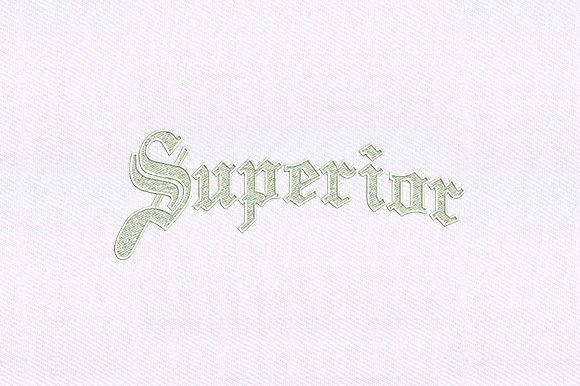
While the potential is high, practical execution demands careful planning. The phrase “Claiming Superior” likely involves lettering. This requires special attention in business applications.
- Small Patch Sizes: If the client wants a tiny patch for a product label or a lapel pin, you must test the design at that reduced size first. Tiny lettering can become blurry or lose definition if the stitch density and spacing aren’t optimized for small scale.
- Cap Fronts and Curved Surfaces: Embroidering on a curved cap front can distort elements. You need to verify how the design’s layout, especially any central focal point, handles this curvature.
- Dark Uniforms and Thread Color Contrast: On dark fabrics like black aprons or navy work shirts, thread color choice is paramount. A test sew in monochrome—first in black thread on white fabric, then white on black—will reveal if the design retains its clarity and impact.
- Frequent Washing: For items like uniforms or tote bags that undergo regular washing, a design with very fine, detailed outlines might wear faster. A robust, slightly bold interpretation would be more durable.
Enhancing Brand Identity and Customer Engagement
Using Claiming Superior effectively is about strategic branding. When a customer sees this phrase embroidered on a staff apron in your boutique, it builds an implicit promise. On merchandise sold in an Etsy shop or at a local event, it transforms a simple item into a handmade product with a story. The visual consistency it provides across uniforms, caps, and bags strengthens brand identity, making the business more memorable and professional.
This design can directly affect buyer engagement. A well-executed embroidered patch on a tote bag feels tangible and valuable, encouraging customers to use and showcase the item, effectively becoming brand ambassadors. For a small business, this kind of subtle, quality branding often resonates more than loud, generic graphics.
Professional Designer Notes for Project Success
Before running this digital embroidery file for any commercial embroidery project, follow these steps to ensure a flawless finished product for your client.
- Test on Real Fabric: Hoop a sample of the actual fabric type—whether it’s canvas for a bag, twill for a cap, or polyester for a uniform—with the correct stabilizer. Observe how fabric texture interacts with the stitch pattern.
- Check Hoop Size Compatibility: While specific hoop dimensions aren’t provided here, you must confirm the design’s maximum and minimum recommended hoop size from the file details to ensure it fits your intended applications, from large tote panels to small patches.
- Create a Printable Mockup: Before production, generate a mockup for client approval. This helps them visualize the design on their merchandise and confirm placement and size.
- Compare Design Assets: Place the embroidered sample beside the business’s other branding elements (logo, fonts, colors) to check for visual harmony.
- Confirm Commercial Licensing: Always verify the license terms for this embroidery file before using it for business merchandise. The provided format list is for technical use; the legal use for resale on products must be clear.
Final Thoughts on Claiming Superior as a Business Tool
In my review, Claiming Superior stands out as a design with significant business potential beyond its Inspirational category. Its value lies in its ability to communicate a brand promise through the trusted, tactile medium of embroidery. For the small business owner, craft business, or merch creator, it offers a path to elevated, consistent branding across uniforms and products. For the embroidery shop or apparel decorator, it represents a versatile, multi-format file ready for diverse projects. Success, however, is not automatic. It requires the designer’s diligence in testing, adapting, and placing it with strategic intent. When executed with care, this design can truly help a business claim its superior space in the market, stitch by stitch.